
Measure the value before you buy
To prove return on investment (ROI) from a software free trial, measure improvements in productivity, costs, accuracy, and workflow efficiency during the trial period. Evaluate how the software integrates with existing systems, gather feedback from users across the business, and assess whether the solution can scale with your needs. Using measurable trial data helps build a strong business case for software investment.
Free trials are one of the best ways to explore new software and assess whether it is the right fit for your business. They provide hands-on experience with new technology before any financial commitment is made. However, while testing features and functionality is important, the real challenge is proving the return on investment (ROI) the software could deliver once fully implemented.
Being able to demonstrate value is a critical part of the software evaluation process. Clear ROI metrics help build a business case for stakeholders, support budget approval, and increase confidence in the purchase decision.
What does ROI mean in a software free trial?
ROI (Return on Investment) in a software free trial is the estimated value a business could gain from the software compared to the purchase and implementation cost. The value can be seen in time savings, reduced errors, lower operational costs, increased sales, or improved productivity.
When evaluating software during a free trial, focus on identifying measurable outcomes that can be compared against your current processes. The more evidence you can collect during the evaluation period, the easier it becomes to justify the investment.
Key factors to consider during a software free trial
The ability to demonstrate value to your business is an important part of the decision-making process. It will enable you to provide metrics to key stakeholders approving the budget and increase the likelihood of buy-in from other areas of the business.
Additionally, there are other factors to consider when calculating ROI, such as how the new technology will fit with your existing systems, whether it can be scaled to work with the growing needs of your business, and how other people will use it.

1. Business value
The most effective way to prove ROI during a software trial is to identify the areas of your business where the software could have the greatest impact.
For design automation software, this means reviewing the workflows that could be streamlined or automated. Every business has unique processes, so understanding where automation can eliminate repetitive tasks will help build a more accurate picture of potential value.
Key value metrics to measure can include:
- Design generation time
- Design generation costs
- Accuracy and reduction in errors
- Average design completion time
- Design hours required each month
- Quote turnaround times
- Time spent on repetitive engineering tasks
Business value summary
Businesses can prove ROI by measuring time savings, reduced costs, improved accuracy, and increased operational efficiency during the free trial period. Using real workflow data delivers the most accurate ROI projections.
Calculate an ROI for DriveWorks Solo based on automating one of your own products and see how quickly you could benefit from using DriveWorks.

2. Technology fit
The value of a software solution also depends on how effectively it works with your existing technology environment.
Software that integrates seamlessly with existing systems often delivers value faster because it:
- Reduces implementation complexity
- Minimizes disruption to existing processes
- Eliminates duplicate data entry
- Improves information accuracy
- Lowers support and maintenance costs
Technology fit summary
Software that integrates easily with existing business systems typically delivers a higher ROI because organizations can realize value faster and avoid costly implementation challenges.

3. People and adoption
One of the most overlooked aspects of proving ROI is involving people from across the business during the trial period.
Different departments often experience different benefits. Design teams may see efficiency improvements, while sales teams benefit from faster quote generation and operations teams see improved process consistency.
Benefits of involving multiple stakeholders include:
- More comprehensive feedback
- Better understanding of business-wide impact
- Greater stakeholder buy-in
- Smoother implementation and adoption
- Earlier identification of training needs
People and adoption summary
User adoption plays a significant role in software ROI. Involving stakeholders during a free trial helps to understand the full business impact and increases the likelihood of successful implementation.

4. Scalability
A software solution may provide immediate benefits, but long-term ROI depends on its ability to support future business needs.
When evaluating software scalability, ask:
- Can it handle increased workloads?
- Will it support future business growth?
- Can it manage more complex product configurations?
- Will performance remain reliable as usage increases?
Scalability summary
Scalable software delivers greater long-term ROI because it continues to provide value as business requirements evolve, reducing the need for future software replacement or reimplementation projects.
Frequently asked questions
How do you calculate ROI from a software free trial?
Calculate ROI by comparing projected business benefits, including time savings, cost reductions, productivity improvements, and revenue gains, against the expected software investment and implementation costs.
Why is scalability important for software ROI?
Scalable software supports future growth without requiring any replacements or major redesigns, increasing the long-term value of the investment.
How long should a software trial be to measure ROI effectively?
Most businesses can identify measurable ROI indicators within a 30-day trial by testing the software against real workflows and business processes.
Calculate your ROI with DriveWorks Solo
DriveWorks Solo helps design engineers automate repetitive SOLIDWORKS® tasks, reducing manual effort and enabling teams to focus on innovation and new product development.
By automating the process of designing, configuring, and selling custom products, businesses can improve efficiency, accelerate sales cycles, and reduce operational costs.
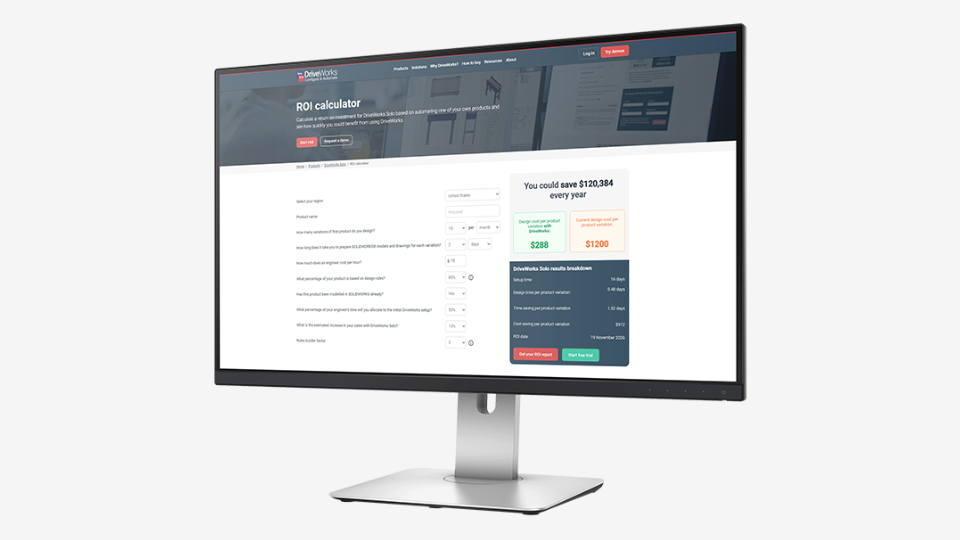
Use the DriveWorks Solo ROI Calculator to estimate your return on investment based on automating one of your own products and discover how quickly you could benefit from using DriveWorks.
Getting started is easy with a 30-day full-feature trial.